Gap Analysis
Find undefended ATT&CK techniques from Detections → Gap Analysis.
Detections → Gap Analysis identifies the specific points where your ATT&CK technique coverage and D3FEND defensive controls do not align. It cross-references the two frameworks using 305 technique-to-control mappings and surfaces the techniques that lack effective defense.
Open Gap Analysis
- Go to Detections → Gap Analysis.
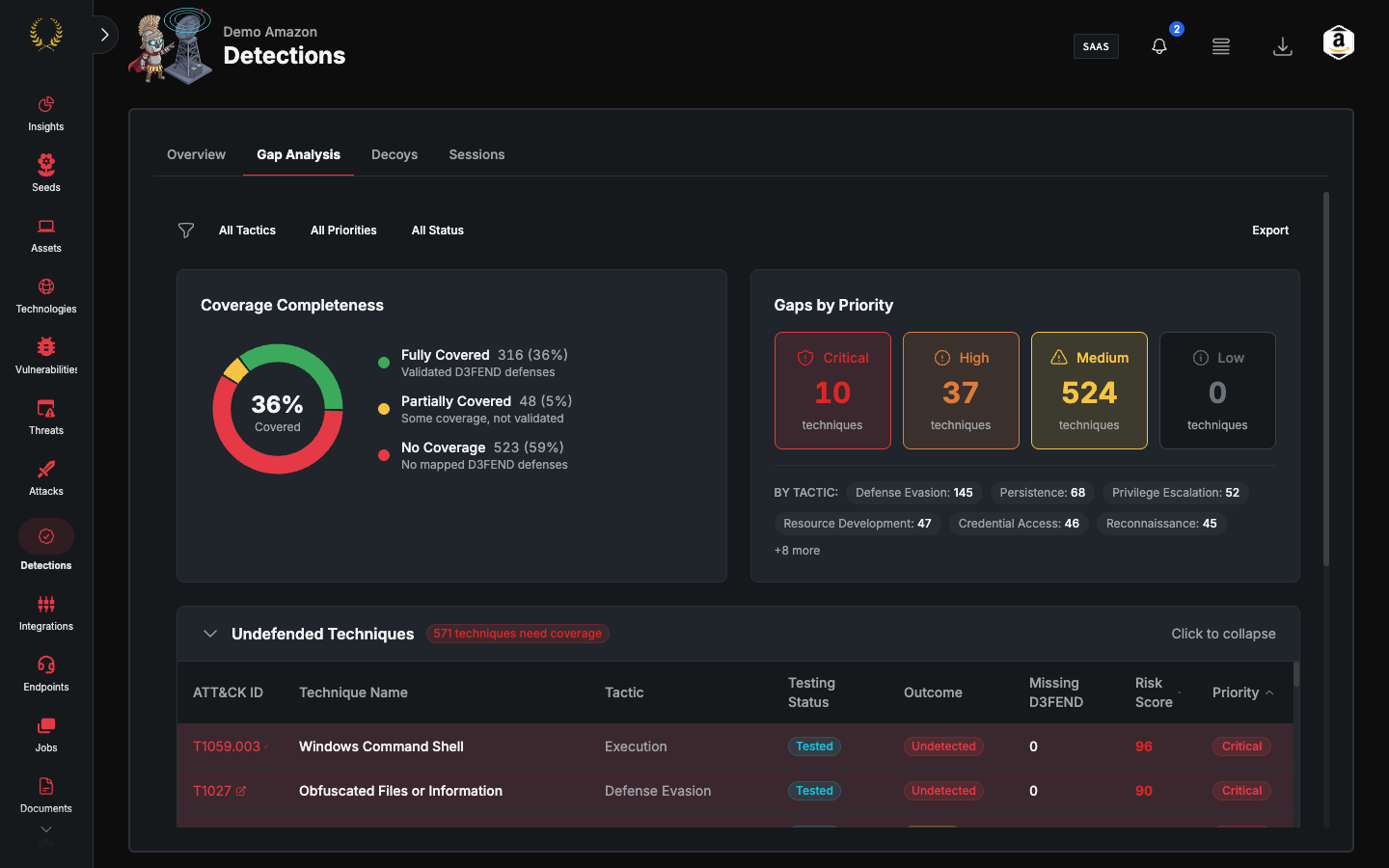
Filters and Export
Filters at the top let you narrow results by:
- Tactic — Filter by ATT&CK tactic (e.g., Initial Access, Lateral Movement)
- Priority — Filter by remediation priority (Critical, High, Medium, Low)
- Status — Tested or Untested
All filter state is synchronized with the URL, so filtered views can be bookmarked or shared. Open Export, then choose Export CSV or Export JSON.
Coverage Completeness
A donut chart visualizes how techniques break down across three coverage levels:
- Fully Covered — At least one mapped D3FEND control is deployed and rated Effective or Highly Effective
- Partially Covered — A D3FEND control is deployed but is not rated as effective
- No Coverage — No mapped D3FEND control is deployed
Gap Summary Statistics
A statistics panel breaks down gaps by remediation priority and by ATT&CK tactic, giving a quick view of where the largest concentrations of gaps exist.
Priority is calculated from prevalence weight and defense status:
Undefended Techniques Table
The main table lists every ATT&CK technique that lacks effective defensive coverage. Columns include:
- ATT&CK ID
- Technique Name
- Tactic
- Testing Status — Tested or Untested
- Outcome
- Missing D3FEND — Number of recommended D3FEND controls not effectively deployed
- Risk Score — 0-100 composite of prevalence weight, defense status, and test outcome
- Priority — Remediation priority level
Clicking a row opens a drawer for that technique: which D3FEND controls are recommended, their current presence and effectiveness status, and specific remediation guidance.
Ineffective Controls Table
A collapsible section below the main table lists D3FEND controls that are deployed but not performing effectively. Each entry shows:
- The D3FEND technique name and current effectiveness rating
- How many ATT&CK techniques it is supposed to protect against
- A recommended action: Tune (for Partially Effective controls) or Replace (for Ineffective controls)
Use this table to decide which controls to tune or replace.
Support
If the gap list looks empty on a live tenant, confirm hunts have run, then reach out to support@praetorian.com.
Still need help? Ask the team